
Water Renewal
Plainwell's wastewater treatment plant at 129 Fairlane Street, serving the city and parts of three neighboring townships.
The City of Plainwell’s award-winning Water Renewal Department works every day to recycle water back into your environment.
Collection system
Sewer mains collect the wastewater from homes, businesses, and industries. With the help of interceptors and pumping stations, this wastewater is conveyed to the treatment plant. The City of Plainwell has over 15 miles of sewer lines in its system, and 7 pumping stations. The service area extends into Otsego Township (which has two pump stations), the Village of Martin (which has three pump stations), and Gun Plain Township with 24 pump stations.
Preliminary treatment
In preliminary treatment, the pollutants that would be harmful to mechanical equipment are removed or reduced to a manageable size. Large objects such as rags, sticks, as well as abrasive grit, are examples of the materials handled in this step. The Plainwell Water Renewal Plant uses a quarter inch mechanical bar screen with a compactor. This process removes rags and large debris, to protect up stream treatment processes. The waste from this process is hauled to landfill.
The flow from this process enters into an aerated grit tank. Here the abrasive grit is removed from the waste stream. Air is injected to the tank at a rate that keeps the lighter organic matter in suspension, but allows the heavier inorganic matter to settle. The settled matter (grit) is piped to a separator that removes the grit and returns the liquid back to the incoming flow. The sewage that leaves the aerated grit tank is sent to the next stage, which is primary treatment.
Odor removal is also accomplished at this stage of treatment. This part of the process is covered and is under negative pressure to create a vacuum. The air from this is drawn through a mulch type media called a “Biobed.” This process removes noxious gasses which are offensive and corrosive to treatment equipment.
Primary treatment
In primary treatment, the organic matter that floats or settles to the bottom of the clarifiers is removed. Plainwell’s plant has five primary clarifiers. Each clarifier holds 15,300 gallons of water. The flow is normally split between all five clarifiers. At current flows, we have a 3.3 hour detention time in this portion of the plant. The floating matter is skimmed off and sent to landfill for disposal. The settled matter is collected by scrapers on the bottom of the tanks and is pumped to the digesters for additional treatment. The water that flows out of the primary clarifiers is sent to the next stage of treatment called secondary treatment.
MBBR and secondary treatment
The MBBR process is a state-of-the-art fixed-film (or attached growth) biological process used for wastewater treatment both municipally and industrially for BOD removal, nitrification and denitrification. A Moving Bed Biofilm Reactor (MBBR) consists of a tank with submerged but floating plastic (usually HDPE, polyethylene or polypropylene) media having specific gravity less than 1.0. The large surface area of the plastics provide abundant surface for bacterial growth. Biomass grows on the surface as a thin film whose thickness usually varies between 50-300 microns. Medium or coarse bubble diffusers uniformly placed at the bottom of the reactor maintain a dissolved oxygen (DO) concentration of more than 2.5-3 mg/L for BOD removal. Higher DO concentrations are maintained for nitrification. To retain the media flowing out of the tank, screens are placed on the downstream walls. No sludge recycle is required for this process.
Wastewater enters the Moving Bed Biofilm Reactor where the biomass attached to the surface of the media degrades organic matter resulting in BOD removal and/or nitrification depending on the type and characteristic of the wastewater. Organic carbon is converted to carbon dioxide and leaves the system while the ammonia and nitrogen in the organics are converted to nitrates through nitrification process. Oxygen required for the process is provided through the diffusers installed at the bottom of the reactor. The treated wastewater then flows through the screens to the downstream final clarifier.
There are more than a thousand Moving Bed Biofilm Reactor installations worldwide. Moving Bed Biofilm Reactor technology can be used for wastewater treatment for the following industries: food and beverage plants, steel mills, oil refineries, petrochemicals, chemical plants, paper mills and any industries requiring wastewater treatment for BOD removal, nitrification and denitrification. MBBR technology has become the preferred biological treatment technology because it offers several advantages over the traditional Activated Sludge Process, the most popular technology. Also, because of its lower costs and high treatment quality.
Phosphorus removal
Phosphorus has been identified as one of the substances which disrupts the ecological balance of our waters. Both chemical additions and biological treatment reduce the amount of phosphorus in the effluent of the treatment. The discharge limit set for the City of Plainwell is 1.0 mg/l, which means that it must be less than one milligram per liter of water leaving the plant.
Ferric chloride is used at the plant and is pumped in by metering pumps in various places in the treatment process to achieve phosphorus removal. The soluble phosphorus is removed by the ferric chloride which removes the insoluble phosphorus. This is done by flocculation of the solids of the water. The ferric chloride binds or coagulates the solids and settles them out in the primary clarifiers. Most of the phosphorus is removed along with the solids. The remaining phosphorus is removed by secondary or biological treatment.
Disinfection
Disinfection is the destruction of disease-causing bacteria and viruses prior to discharging the treated water to the Kalamazoo River. Plainwell has two chlorine contact tanks where chlorine is applied. The wastewater has a detention time in the tank of just over 1.5 hours. The tank is baffled to allow a complete mix of treated wastewater with the chlorine solution. A separate chlorinator capable of feeding 50 pounds per day of chlorine is used to feed the chlorine to each tank. Normal application rate is 7-10 pounds per day total.
To reduce the toxicity that chlorine may have on some of the organisms in the river when the treated wastewater is discharged, the flow is dechlorinated before being released to the river. Sulfur dioxide is applied at a rate that reduces the chlorine in the discharge to less than 0.0365 parts per million parts of chlorine. A separate sulfonator capable of feeding 10 pounds per day of sulfur dioxide feeds the sulfur dioxide to each tank. Because the reaction is immediate, the sulfur dioxide is applied at a point just prior to the discharge of the tank. From the chlorine contact tank the treated wastewater is discharged into the Kalamazoo River.
Bio-solids treatment
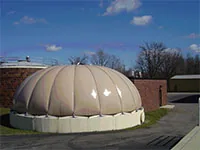
In the sludge facilities, the solids that settled in the previous steps are prepared for final disposal. The solids are stabilized to kill disease-causing microorganisms and to prevent the development of odors. At the present time, Plainwell has two fixed cover digesters, one secondary digester, and two holding tanks. Each of the primary digesters holds 104,000 gallons of sludge. The secondary digester/Dystor operates at a 40,000 gallon level. Each holding tank holds 500,000 gallons, bringing the total capacity to 1,440,000 gallons of sludge.
The primary digesters are heated to 95 degrees Fahrenheit and circulated to enhance the digestion process. The methane gas produced by this breakdown is collected in the cover tanks and used to heat water that in turn heats the sludge. By doing this, we reduce the plant’s natural gas costs. We currently feed 7,200 gallons of sludge on a daily basis. To maintain mixing in the primary digesters, sludge is transferred to the secondary digester and finally to the storage tanks. Here the sludge is allowed to settle. The clearer liquid, which remains on the surface, is called supernatant. This is returned to the head of the plant to be treated with the wastewater entering the plant.
Bio-solids disposal
The biosolids are then recycled as soil nutrients. The treated sludge must be disposed of in a safe and environmentally sound manner. The City of Plainwell applies liquid sludge to farmland for its fertilizer value. The sludge contains phosphorus, nitrogen, and potassium as well as other nutrients that crops need for growth. An independent contractor has been hired by the City to handle this job. They test the sludge and the soil to determine appropriate application rates. They then obtain approval by the MDEQ (Michigan Department of Environmental Quality) for safe application of the sludge. We currently apply sludge once per year at a quantity of approximately 500,000 gallons. Crops grown on the fields are for secondary human consumption only, meaning that the crops need to be used as animal feed first.
Laboratory analyses
Tests performed daily by plant staff at Plainwell include the following: suspended solids, biochemical oxygen demand, pH, dissolved oxygen, phosphorus, ammonia nitrogen, and fecal coliform bacteria tests. These tests tell us what effect the treatment is having on the treated wastewater. The MDEQ and U.S. EPA place limits on what can be discharged and this testing also proves compliance with the required limits.
Related links
History of the Water Renewal Department
Early years
During the mid 1950s, Plainwell constructed a wastewater treatment plant with a trickling filter as the secondary treatment. Prior to this, raw sewage was discharged to the Kalamazoo River. During the 1970s, the area was growing and regulatory constraints were becoming an issue at the plant.
With help of an EPA grant it was time to expand the treatment plant. The project cost $3 million and was completed in the early 1980s.
The improvements gave the plant a 1.3 million gallon per day capacity. Our current flow is 500,000 gallons per day. The new improvements included installation of two new 30-foot screw pumps, conversion of the old primary and secondary tanks to just primary clarifiers, removal of the undersized trickling filter from service, and installation of new Rotating Biological Contactors (RBCs). A new sludge heat exchanger, a new secondary pump room, two new final clarifiers, and a new chlorine contact chamber were also added. As expanded, the Superintendent in charge of the new plant was required to have a class B State of Michigan wastewater treatment license.
1992
In 1992, the City built a 500,000 gallon tank for additional bio solids storage.
1998
In 1998, the City invested $500,000 to renovate some of the equipment from the 1980 project. This included improved primary clarifier flow distribution, new primary clarifier hardware, and a new “channel monster” for preliminary treatment. Major renovations to the digester building piping, and a new chopper pump for improved digester mixing. Two new secondary clarifier pumps and piping, and a new raw sludge pump and piping.
2002
In 2002, the City built a second 500,000 gallon biosolids holding tank. The construction cost for the poured wall tank was $780,000. The tank was designed to accommodate future walls that would be poured vertically to increase future storage needs.
2003
In 2003, the City was awarded first place in the EPA’s “Award of Excellence.” The award is chosen from the five states which make up the region and is headquartered in Chicago. The Region 5 EPA award is for outstanding operation and maintenance of a medium secondary treatment facility.
2005
In 2005, the City completed a $1.7 million expansion for bio-solids digestion and methane gas storage. The methane gas holding dome called “Dystor” cost $250,000 to install and enables the City to use and store 30% more gas than conventional tanks. The “Green Project” result of this technology allows the City to heat eight buildings with hot water including the Department of Public Works. The annual natural gas savings from the project each year is $18,000.